

Barber County
KSGenWeb

The Barber County Index, Thursday, May 16, 1929.
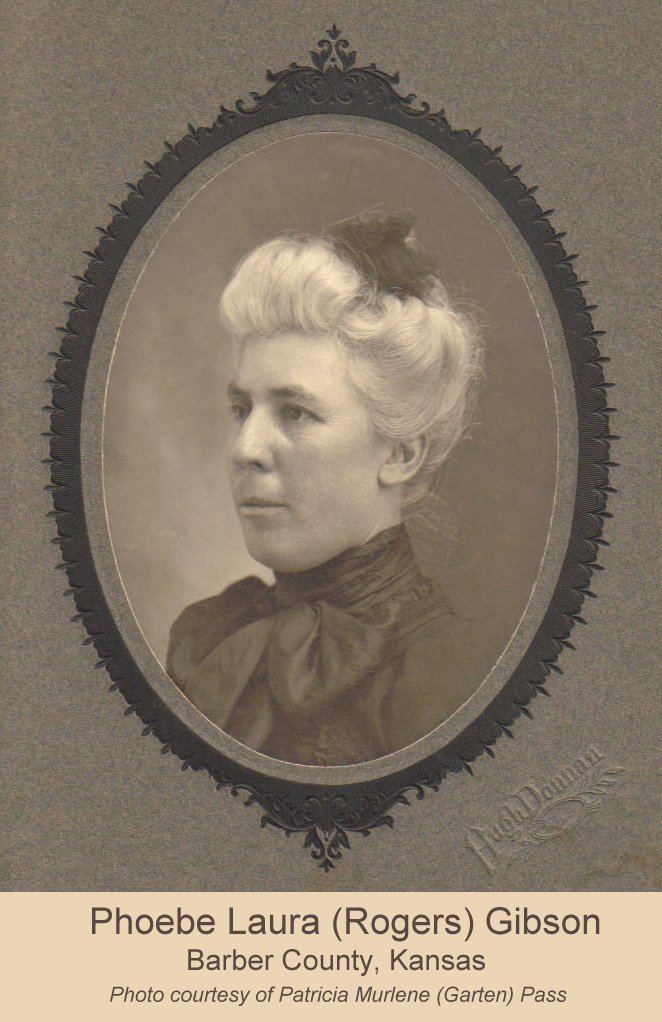
Phoebe Laura (Rogers) Gibson
Photo courtesy of Patricia (Garten)
Pass.
View Larger Image
My recollection of Barber County covers nearly
fifty-six years. My father, William Rogers, made a short trip out here
in 1872 and located a homestead on Bitter Creek, then came back for the
family. On the 23rd of October, 1873, we arrived here from Lee Summit,
MO where we had lived several years since coming from our home in
Virginia. There were my three sisters, one brother and my father,
traveling in a covered wagon. We brought with us a cow, two pigs and a
cat. We came by way of Hutchinson, which was only a little town, and
arrived in Medicine Lodge in
the early afternoon. That evening we went on up the river to where
father had located. This was across the Medicine River south on Bitter
Creek and is now known as the old Gant place.
Dick Woodward, H.H.
Woodward's father, for whom Dick's Peak is named, was our near neighbor.
He had been here several years hunting buffalo and had helped father
select our homestead. He was well acquainted with the country and his
word was law to the settlers.
That winter, we lived in a log house
with dirt floors and a dirt roof. It had a fireplace made of red
sandstone. It was just a one room house. It was much colder than it is
now, but we did not suffer from the cold, for there was wood in
abundance. There was plenty of buffalo, wild deer and turkey, so we had
lots of meat. Next spring, father built a more comfortable house. It was
made of logs and boards and had two rooms. The boards came from John
Easley's mill.
We were living in this new house when in June, about
the 10th or 15th, Dick Woodward came riding up and said "Mr. Rogers, we
must get out of here. The Cheyenne's are on the war path and have
already killed some people near Medicine
Lodge on Cedar Creek." Father knew that was no false alarm, coming
from Mr. Woodward. While Mr. Woodward went on to his house to get his
family, we loaded in what we needed and left in a hurry.
We went
across the river north to the highest point southwest of where the
Forest City Church now stands. There were about sixty people gathered
there with their wagons and teams. They made a corral of their wagons
and put the women and children inside this enclosure and here we camped
that night. The men stood watch all night. During the night and several
nights following, the hills south of us were lighted by the signal fires
of the Indians.
The next day, the men divided up their work, some of
them stayed there, made the ditch and watched the camp. And the others
took their teams and went down to the river to cut down trees. They
plowed a couple of furrows around a sixty foot square, made a ditch two
feet deep and two feet wide. In this they stood the tree trunks that the
men cut, on end close up like boards, then banked and about four feet
high around this. We had one wagon gate, and there was another gate with
a little hallway so that if the Indians attacked, they would have to
come through this gate, one at a time, and this gate was guarded all the
time.
Each family had a little booth to live in. There were about ten
families that made their homes in that sixty-foot square. They built
these booths with wagon sheets, tents, boards or just anything they
could get hands on. The making of the stockade and booths took days.
During this time, every morning, some of the men would go out and kill a
buffalo and that suppled us with fresh meat, and the tallow was used for
butter and to cook with. They hauled our water from the river in barrels
and we got our groceries from Medicine
Lodge and Lake City. We were
there about a week before the United States Calvary troops came down.
They were a wonderful sight to we children. They patrolled between
Medicine Lodge and Lake
City.
The Indians never attacked the stockade, but Doctor Bond,
who lived between Lake City and
us, would not come into the stockade, and had boasted that he could kill
all the Indians there were around with his pegging awl. But one morning,
he started to Lake City, and a
band of the Indians saw him and attacked him. He threw himself on the
side of his pony and started shooting at them. The troopers at
Lake City heard the shooting and
started to his rescue. The Indians heard them coming and got away into
the hills. After that, Dr. Bond gladly stayed in the stockade.
These
Indians who had been making these raids were camped on Sand Creek,
northeast of Medicine Lodge,
unknown to the settlers. About 10 days after the raid west of town, the
militia ran into them and a fight ensued. I don't know how many were
killed, but I remember that Frank McAllister had killed a chief and took
all his trappings and had three fresh Indian scalps on his belt, and of
course, childlike, I ran over and examined them.
Things settled down
after that, but we were not allowed to leave the stockade, and there we
lived until it was safe to our farm. During that summer, we children had
to amuse ourselves the best we could, as long as we stayed in sight. We
could find ant hills covered with Indian beads that the ants had carried
in, and we could see the teepees along the river. We found lots of
pottery, arrow heads and shells, and things that the Indians had left.
We lived in this stockade until the winter of 1874.
About 400 Pawnee
Indians came down that winter. They were a peaceable tribe. They camped
about five miles from our house. They often came to our house and father
would give them food.
The fall that we came, father was near the
divide south and found a place where the Indians buried their dead. They
built platforms up in the trees and put the dead, bedecked in their
trappings, on these platforms.
My oldest sister was married on New
Year's Eve in 1873, to John
Henry Garten. They were the first couple to be married in Barber
County. They are now living in Sun
City. This left me, a thirteen year old girl, to keep house. But we
had such a good Christian father, that he cared for us the best he knew
how, and that was very good. We lived with him on the farm until we were
married.
"We had a school in a little log school house for several
years. There was no school at all for about two years after we came out
here. The desks were made out of cottonwood and cedar. The school houses
were built the same way as our houses. They were built of logs and then
filled with mud mortar. The roofs were made of logs and brush and dirt
and whenever it rained, they dripped and dripped.
It was in the year
1875 that the grasshoppers came and ate up everything, even to the
posts. There was no bark left on the trees and everything green was
eaten up. They came in great clouds. They covered the ground. You
couldn't even walk without crushing them. They stayed about three days,
until everything was eaten up. The settlers freighted cedar posts and
buffalo bones to Hutchinson and brought back the bulk of our supplies.
They would pull up the cottonwood shoots that grew along the river, and
in the spring they sold them to the settlers on the prairie north of
here on the way to Hutchinson. That is where the groves of trees that
are now up there came from. These trips meant that the men would be gone
for at least a week at a time.
One of the dangers we constantly had
to look out for were rattlers. We always tried to kill every one we saw.
Another menace was the gray wolves. Of course there were many coyotes,
but it was the wolf that would carry off the hogs and calves. And they
were to be feared if one got caught out alone. One night in 1875 when I
was staying with my sister while John was gone, her tiny baby cried, and
in a few minutes we heard the wolves howling close, then they were
scratching and sniffing at the door.
We pulled the table and whatever
we could move against the door, for gray wolves are large and could have
pushed the door in. The howling of the wolves as they ran around and
around the dugout surely gave us a scare. Finally, after we got the baby
quiet, they left.
Our mail came from Hutchinson by way of stage
coach. Bill Horn drove from
Hutchinson to Medicine Lodge.
He came just about once a week.
Medicine Lodge was, of
course, the county seat at that time, and it kept gradually building up.
We didn't come to Medicine
Lodge very often, about once a month. There were two or three brick
kilns where the depot is now, and they turned brick there and some of
the houses were built of them, and others were built of cottonwood
lumber and filled in with bricks. The jail was made of logs and it stood
somewhere near where Mr. Braggs' office is now. At that time, there were
two saw mills here. The lumber was mostly cottonwood. There were only
two or three houses in Medicine
Lodge in 1973, a blacksmith shop, one store, a livery barn and a
little eating house.
My husband and
I were living in Medicine Lodge,
running a restaurant, when the
First National Bank was
robbed. That day, Mr. Gibson happened to be at the ranch which he owned
north of town. About nine o'clock, I heard someone running and shouting
that the bank had been robbed, that the President and Cashier had been
killed. But they did not get the money. There were four of them. They
had their horses back of the bank. They started south.
Immediately,
about a dozen cowboys took off after them and never lost sight of them.
Unlike the vigilantes of today, they were already well armed. A few
miles from town, the horse of one of the robbers was shot down, so he
jumped on behind one of the others. They took to the hills and went up
the canyons. It was a rainy morning and the robbers huddled up under a
ledge in a sort of cave. The cowboys surrounded them, but the robbers
used up all their ammunition on them. Finally they surrendered.
Each
robber was tied on behind a cowboy and thus they came to town, cold and
wet. It was about three o'clock when they got back. When they got back,
they took them off the horses and the sheriff tried to find some place
to get something to eat. Nobody would let them come in, so the sheriff
came and wanted to know if I would let him bring them in and feed them.
He said "Of course you won't have to do anything, the boys can wait on
the table, if you will let us in." So I said "all right, you can bring
them in." So they brought them in and set them down, two at a table.
They were shackled with one hand and one foot to a cowboy. The room was
lined around with armed men, as well as the street and alley. I went in
and walked through the room that I might get a good look at them.
After they were fed, they were put in the jail and a guard placed near
them. We could tell then that something was going to happen. Mr.
Gibson came home before night. All was quiet except for a lot of
shouts. A mob had gathered to take out the prisoners. When the door was
opened, they made a dash for liberty.
Volleys of shots were fired.
One of the robbers was wounded. They took them east toward Elm Creek on
the flat and hung all four of them from an elm tree. The families of two
of the men were notified, but they would not claim the bodies, so all
four of them are buried in our cemetery here.
In a few weeks there
was hardly any bark left on the tree from which the robbers were hung,
as everyone got a piece for a souvenir. I still have the piece I got.
Other stirring times were the terrible blizzards in which people lost
their lives, and the cattle froze to death, and what lived, their horns
dropped off. And the flood that cost so many lives, but someone else can
tell about them.
As I look back on these early days, I realize we
have come a long way, and feel so thankful for the conveniences and
pleasures I now enjoy."
-- by Mrs. Phoebe Rogers Gibson.
PIONEER WOMAN DIES AFTER LONG ILLNESS
Phoebe Rogers was born in
Braxton County, West Virginia, near the town of Sutton, June 20, 1860
and died at the home of her daughter, Mrs. S. A. Harrison, November 20,
1937 at the age of 77 years and 5 months.
Owing to the ill health of
her brother, she was brought by her parents on a steamboat to Jackson
County, Missouri, in 1866. Here the first deep sorrow came into her
life. Her mother, no longer able to endure the hardships of a pioneer
life, passed to her heavenly home.
Her uncles made a hunting trip
through Kansas and brought back the news of a wonderful new land in
Barber county. The father equipped a covered wagon and started with his
family to this land of great promise, arriving south of the river near
Forest City, October 23, 1873. The first winter was spent in an old log
house built by some early buffalo hunters. The first summer was spent in
the "stockade" due to some roving Indians who were plundering and
killing in this section of the state. The next fall, the father made a
home for his family in a dug-out close to the "stockade" as the Indians
had not ceased in their raids. Mrs. Gibson often related wonderful tales
of these trying days, and of the hardships of the early pioneers in
Barber County.
She was united in marriage to Joseph Pinekney Gibson,
April 18, 1881. To this union five girls were born: Cornelia Mabel,
Ethel, Gladys, Edith Fern, and Helen Josephine. Her husband and the two
oldest daughters preceded her in death.
She was reared in a Christian
home. Her father was a very earnest Christian. For many years, he led
the singing in Sunday School and church. He was superintendent of the
Sunday School many times. She was converted early in life and lived
faithfully as a Christian all through the years. She and her husband
united with the Methodist Episcopal church in
Medicine Lodge, October 29,
1884. She was always a lover of the church and freely gave of her talent
and her time to her Christ and her church. She was a faithful member of
the official board many years. She was a militant member of the W.C.T.U.
all through the years. She joined Carrie
Nation in her raid on the Day Drug Store here in
Medicine Lodge years ago
when the liquor laws were being violated openly.
When she became the
wife of Mr. Gibson, she
became the mother of his four children, Will and John, Mary and Carrie,
from a former marriage. Her great mother heart opened to them and they
loved her and honored her as did her own daughters. She was always ready
to make any sacrifice for the welfare of her children. Her unwavering
faith in each of them and her encouragement in their early years proved
a never-failing source of inspiration.
She was a great lover of
flowers and would find great delight among them and continued her care
of them when her frail body would hardly respond to the strong will that
was ever manifest in every trial of her life. She scattered her beloved
flowers far and wide, in the church she loved so much, in the sick room
of friends and strangers.
She was never of rugged health and when a
few years ago, she was warned that her days were limited, she accepted
this situation without a complaint. She determined that even in her
affliction, she would make all happy that made their way to her
fireside. So these years of weakness and suffering have been years of
service to those whose lives she touched. She was tenderly care for by
her loving daughters, and her devoted son-in-law, Mr. Harrison. She
appreciated everything that was done for her by the loved ones, the
doctor, and the friends. The morning before her departure, her pastor
visited her and she said she put her trust in her Lord and He was taking
care of her, but she was so tired.
She planted, she sowed, a
beautiful Christian life and now her loved ones and friends rise up and
call her blessed.
She leaves to mourn her death her three daughters,
Miss Gladys Gibson, Mrs. E.G. Shell, and Mrs. S.A. Harrison, all of
Medicine Lodge; her four
step-children, W.F. Gibson of Garber, Okla., John Gibson of Oklahoma
City; Mrs. Mary Luallen of
Medicine Lodge, and Mrs. Carrie Patton of Wichita; two sisters, Mrs.
Fred Nurse of Medicine Lodge
and Mrs. Elizabeth Stuart of Walla Walla, Washington, 17 grandchildren,
17 great grandchildren and many other relatives and friends.
Also
see:
Joseph P. Gibson,
husband of Phoebe (Rogers) Gibson.
Green Adams Describe Things
As He Saw Them In Barber County In The Early 1870's
Barber County
Index, October 6, 1927.
Barney O'Conner Tells of Indian Scraps Here:
Early Day Character
Relates Incidents From Fund of Pioneer Knowledge
Barber County
Index, March 27, 1930.
Indians
Killed Her Father Here In 1874
Barber County Index, September 18,
1930.
EARLY DAYS IN BARBER
COUNTY:
Mrs. Jennie Osborn Writes Most Interesting Article Concerning
Experiences In Barber County
Barber County Index, September 29,
1927.
Attempted Bank
Robbery in Medicine Lodge,
The Hazelton Express, May 8, 1884.
Carry A. NATION
(Carrie Amelia NATION) (Photograph)
Author of The
Use and Need of the Life of Carry A. Nation, Revised edition, 1905.
Lee Wynkoop: "Recalls Narrow Escape From
Indians"
(Undated newspaper clippings.)
Thanks to Bonnie
(Garten) Shaffer for finding, transcribing and contributing the above
news article and obituary to this web site and to Patricia (Garten)
Pass for the photograph of Phoebe Laura (Rogers) Gibson!
Copyright © 1996 - The USGenWeb® Project, KSGenWeb, Barber County

This page was last updated
01/28/2026