
Crawford County
KSGenWeb

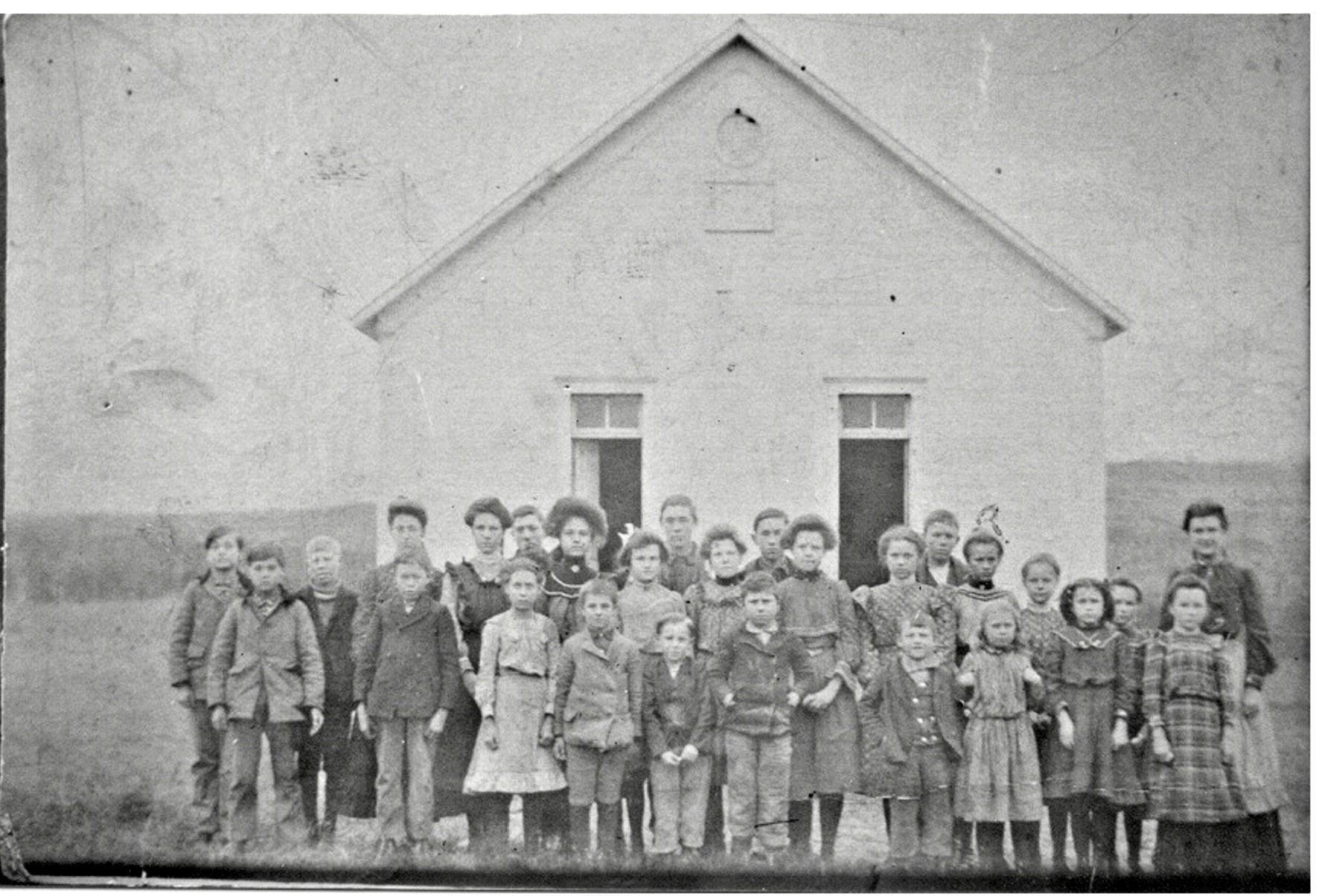
Back Row: standing from Left - Oliver Hamlin, Jake Huber, Lola Brownfield, Engra Bond, Frank Hotellling, Orpha Hamlin, Fred Schilling, Earl Terrell, Frank Hammond, Teacher - Virgia Major.
Second Row: Willie Hamlin, Jack Hammond, Jessie Hotelling, George Huber, Harold Jewell, Jess Bond, Russell Woodbury, Inez Horn, Florence Woodbury, June Schilling.
Front Row Ethel Woodbury, Addie Huber, Cora Woodbury, Esther Schilling
Ida Schilling, Mary Schilling next to teacher.
Contributed by Dovie Kaupke
During the coal mining days in the county, there were many little coal camps that dotted the countryside. Ashley, Barber Camp, Bricker, Burnett Camp, Cambria, Capaldo, Chapman & Hazen Camp, Chicopee, Coalville, Cockerill, Croweburg, Curranville, Dunkirk, Fleming, Foxtown, Fuller, Gross, Iowa Camp, Jacksonville, Kirkwood, Klondike, Litchfield, Lone Oak, Markum, Midway, Mineral City, Radley, Ringo, Schwab, Scott's Camp, Williamstown, Yale (home of the World Famous Chicken Annie's and Chicken Mary's).
Some interesting and humorous names for camps - 4 1/2 Camp, Blue Goose, Breezy Hill, Buzzard's Roost (Bell Camp), Frogtown, Dogtown, Gebo Camp, Little Italy, Pumpkin Center, Red Camp, Red Onion Camp, Washer Camp, Water Lilly.
Some camps were named after the number of the shaft of the major coal companies for which drilled them. The camps were usually built and ran by the coal companies. They consisted of row houses with a company store, where the miners would buy their goods.
The major coal companies were the Sheridan Coal Co., Western Coal & Mining Co., Cherokee-Pittsburg Coal & Mining Co., Central Coal & Coke Co., Mayer Coal Company, Clemens Coal Co., Kansas & Texas Coal Co., Crowe Coal Co., Pittsburg & Midway (P&M) Coal Mining Co., Wear Coal Co. and the Missouri, Kansas & Texa Railway Co.
Company Coal Camps - No. 17 Central Camp, No. 31 Central Camp, No. 41 Central Camp, No. 45 Central Camp, No. 48 Central Camp, No. 49 Central Camp, No. 50 Central Camp (still exists as a hamlet known as Camp 50), No. 51 Central Camp, No. 6 Crowe Camp, No. 9 Hamilton Camp, No. 11 Jackson & Walker Camp, No. 3 Sheridan Camp, No. 5 Sheridan Camp, No. 6 Sheridan Camp, No. 7 Sheridan Camp, No. 9 Sheridan Camp, No. 10 Sheridan Camp, No. 11 Sheridan Camp, No. 14 Sheridan Camp, No. 7 Spencer-Newlands Camp, No. 10 Western Camp, No. 11 Western Camp, No. 13 Western Camp, No. 22 Western Camp.
Contributed by Mark Hill
Crawford County, one of the eastern tier and the second north of the line
separating Kansas and Oklahoma, is bounded on the north by Bourbon county; on
the east by the State of Missouri; on the south by Cherokee county, and on the
west by the counties of Neosho and Labette. It was created by the act of Feb.
13, 1867, and was named for Col. Samuel J. Crawford, at that time the governor
of Kansas. The area of the county is 592 square miles. It is divided into nine
townships, to-wit: Baker, Crawford, Grant, Lincoln, Osage, Sheridan, Sherman,
Walnut and Washington. The general surface of the county is undulating, the
water-courses flowing in three different directions. In the northeast Drywood,
Bone and Coxes creeks flow northward to the Marmaton river; in the west Big and
Little Walnut and Hickory creeks flow southwest to the Neosho; and in the
southeast Lightning, Lime and Cow creeks flow southward, their waters finally
reaching the Neosho.
Crawford county lies in the tract known as the
"Neutral Lands" (q. v.), which were ceded by the Cherokee Nation to the United
States by the treaty of July 19, 1866. Prior to that treaty some were made by
white men to settle within the territory. John Leman, a blacksmith, settled in
Osage township in 1848. In 1851 P. M. Smith located in Baker township, but did
not erect a dwelling, being content to live during his short stay in a tent. A
man named Sears built the first house (a log cabin) in this township in 1856.
Coal was discovered in this township by a government exploring party under Col.
Cowan, and was first mined by parties from Missouri in 1857. As early as 1852 a
number of white men, among whom were Howard, Fowler, Hale and the Hathaways,
settled in Lincoln township, and the first school in the county was opened there
in 1858 in a small log house that had formerly been used as a dwelling, the
settlers contributing the funds to pay the teacher. James Hathaway had
established a blacksmith shop where Arcadia now stands in 1844. Harden Mathews
settled in Sherman township in 1850 and there were a few white men in Walnut
township in 1857. In 1861 the Cherokee Indian agent, acting under orders from
President Buchanan, took a body of United States troops and expelled the
settlers, burning their houses and destroying their crops. Others soon came,
however, to take the places of those who had been driven out. That same year a
man named Banks settled on the Big Cow creek in Crawford township. In the summer
of 1865 John Hobson, Frank Dosser, Marion Medlin and a few others settled in
Osage township, and about the same time J. F. Gates, Stephen Ogden, John
Hamilton and others located in Sheridan township. Settlements were made the
following year in Grant and Washington townships. In Sept., 1866, a postoffice
was established at Cato, in the northwest corner of the present Lincoln
township.
J. W. Wallace, Lafayette Manlove and Henry Schoen were
appointed special commissioners and F. M. Logan county clerk, for the purpose of
organizing the county. The first meeting of the commissioners was held on March
16, 1867, and the first order was one dividing the county into nine civil
townships. The second order divided the county into election precincts. Another
order directed the clerk to give 30 days' notice of an election to be held on
April 15, 1867, for the election of county and township officers, and to decide
the location of the permanent county seat. At the election J. W. Wallace, F. M.
Mason and Andrew Hussong were elected commissioners; F. M. Logan, clerk; and J.
M. Ryan, sheriff. The county seat question was not decided at that time, and in
September Crawfordsville was selected as temporary seat of justice.
At
the general election on Nov. 5, 1867, a full quota of county officers was
chosen, as follows: County clerk, H. Germain; clerk of the district court, C. H.
Strong; probate judge, Levi Hatch; sheriff, J. M. Ryan; treasurer, R. B.
Raymond; register of deeds, H. Coffman; assessor, William Roberts; surveyor, R.
Stalker; coroner, Jacob Miller, attorney, L. A. Wallace; commissioners, Frank
Dosser, I. Evans and Joshua Nance. At this election Girard was selected as the
county seat, and at a meeting on May 11, 1868, the commissioners ordered all the
county officers to remove their offices, records, etc., to that point. The
people of Crawfordsville applied to the district court at the September term for
a writ of mandamus to compel the county clerk to take all records back to
Crawfordsville, claiming that it was the legal county seat. The writ was
granted, but on Nov. 7 a petition, signed by 577 citizens, was laid before the
county commissioners, asking them to order an election for the location of a
permanent county seat. An election was accordingly ordered for Dec. 15, when
Girard received 375 votes and Crawfordsville 312. This settled the question.
The first newspaper published in the county was the Crawford County Times,
one number of which was issued by Scott & Cole on April 16, 1868. After that one
issue the publication office was taken back to Osage Mission. On Nov. 11, 1869,
the first number of the Girard Press made its appearance. It was published by
Warner & Wasser, and was the first paper regularly published in the county. On
July 14, 1871, the office and contents were burned by a mob, the ill feeling
toward the paper being the outgrowth of the troubles over the disposition of the
Neutral Lands. Three weeks later the publication was resumed, the paper
appearing in an enlarged form and better than ever before. It is still running.
The People's Vindicator was started at Girard on July 28, 1870, but suspended in
the following November. Other early newspapers were the Girard Pharos, the
Cherokee Pharos and the Cherokee Index, all of which were started in the early
'70s. There are now published in the county 1 daily (the Pittsburg Headlight)
and 13 weekly newspapers, and one quarterly periodical. One of the weeklies is
printed in the German language.
In 1868 a Catholic parish was established
in Grant township and a house of worship erected. This was the first church in
the county. A Presbyterian church was built at Girard in 1870, and the following
year the Methodist church at Mulberry Grove was established. At the present time
all the leading denominations are represented in the towns and villages of the
county. The first white child born in the county was John Leman, whose birth
occurred in Walnut township in 1859. The first marriage license was issued on
Dec. 27, 1867, to W. M. Breckenridge and Miss Elner Stone. Marriages had been
solemnized in the county before that time -- in fact before the county was
organized -- but the licenses had been procured elsewhere.
On Feb. 5,
1870, the Crawford County Agricultural Society was organized, one of the chief
promoters being Dr. W. H. Warner of the Girard Press, who served as secretary of
the society for six years. The affairs of the society were managed by a board of
thirteen directors, who bought 40 acres a short distance east of Girard, where
fairs were held annually until the society was reorganized and a new fair ground
purchased on the west side of the city. The reorganization took place on May 27,
1882. During the Civil war few settlers in what is now Crawford county were
seriously harassed by guerrillas and bushwhackers, most the outrages being
committed by the notorious Livingston gang. Among those killed by guerrillas
were Capt. Henry M. Dobyns of the Sixth Kansas cavalry, and Capt. John Rodgers,
who established the first store at Cato in 1858. The latter was a member of one
of the Kansas volunteer regiments, but was at home on furlough when the raid was
made in which he lost his life. Four brothers named Tippy came into the county
in the spring of 1866, and two of them were afterward hanged by a posse of
citizens near Monmouth, after they had been tried and found guilty by a jury of
twelve men for participation in the murder of a man named Shannon. Several
skirmishes occurred in the county between the guerrillas and Union troops.
Since its organization Crawford county has suffered severely from storms,
the worst of which was probably the tornado of May 22, 1873. It came from the
southwest and swept across the entire county, leaving desolation in its wake.
Seven persons were killed outright, 34 others were injured, and a large amount
of property was destroyed.
Coal of fine quality underlies the entire
county, some of the veins running five feet or more in thickness. More than half
the coal mined in the state comes from this county. Building stone, cement rock,
fire and potter's clay of excellent quality are abundant in several localities
and though only partially developed are a source of revenue to the owners of the
deposits. Belts of timber averaging about half a mile in width are found along
the streams, the principal varieties being oak, walnut, poplar, hickory and
cottonwood. Some artificial groves have been planted. Agriculture is an
important industry. The five leading crops in 1910, in the order of their value,
were as follows: corn, $999,900; oats, $345,960; hay (including alfalfa),
$187,208; wheat, $142,031; flax, $59,670. Kafir corn, Irish potatoes and sorghum
are also important crops. The value of dairy products for the year 1910 was
$222,558, and the value of all farm products, including live stock slaughtered
or sold for slaughter, was $2,660,750.
Crawford county is well provided
with transportation facilities, lines of the Atchison, Topeka & Santa Fe, the
St. Louis & San Francisco, the Missouri, Kansas & Texas and the Missouri Pacific
systems crossing the county in every direction and giving the county nearly 220
miles of main track. Pittsburg is one of the greatest railroad centers in
eastern Kansas.
According to the U. S. census for 1910, the population of
Crawford county was 51,178, a gain of 12,369 during the preceding ten years,
making it the fourth in the state in population. There are eleven incorporated
cities in the county, viz.: Arcadia, Arma, Cherokee, Curranville, Frontenac,
Girard, Hepler, McCune, Mulberry, Pittsburg and Walnut. Other important towns
and villages are Beulah, Brazilton, Cato, Chicopee, Croweburg. Dunkirk,
Englevale, Farlington, Franklin, Fuller, Midway, Monmouth and Yale. (See
sketches of the towns and cities.)
Contributed by Ron Prost, transcribed from Kansas: A Cyclopedia of State History, embracing events, institutions, industries, counties, cities, towns, prominent persons, etc. ... / with a supplementary volume devoted to selected personal history and reminiscence. Standard Pub. Co. Chicago: 1912. 3 v. in 4.: front., ill., ports.; 28 cm. Vols. I-II edited by Frank W. Blackmar, Pages 471-474.
Copyright © 1996 - The USGenWeb® Project, KSGenWeb, Crawford County

This page was last updated
07/24/2026